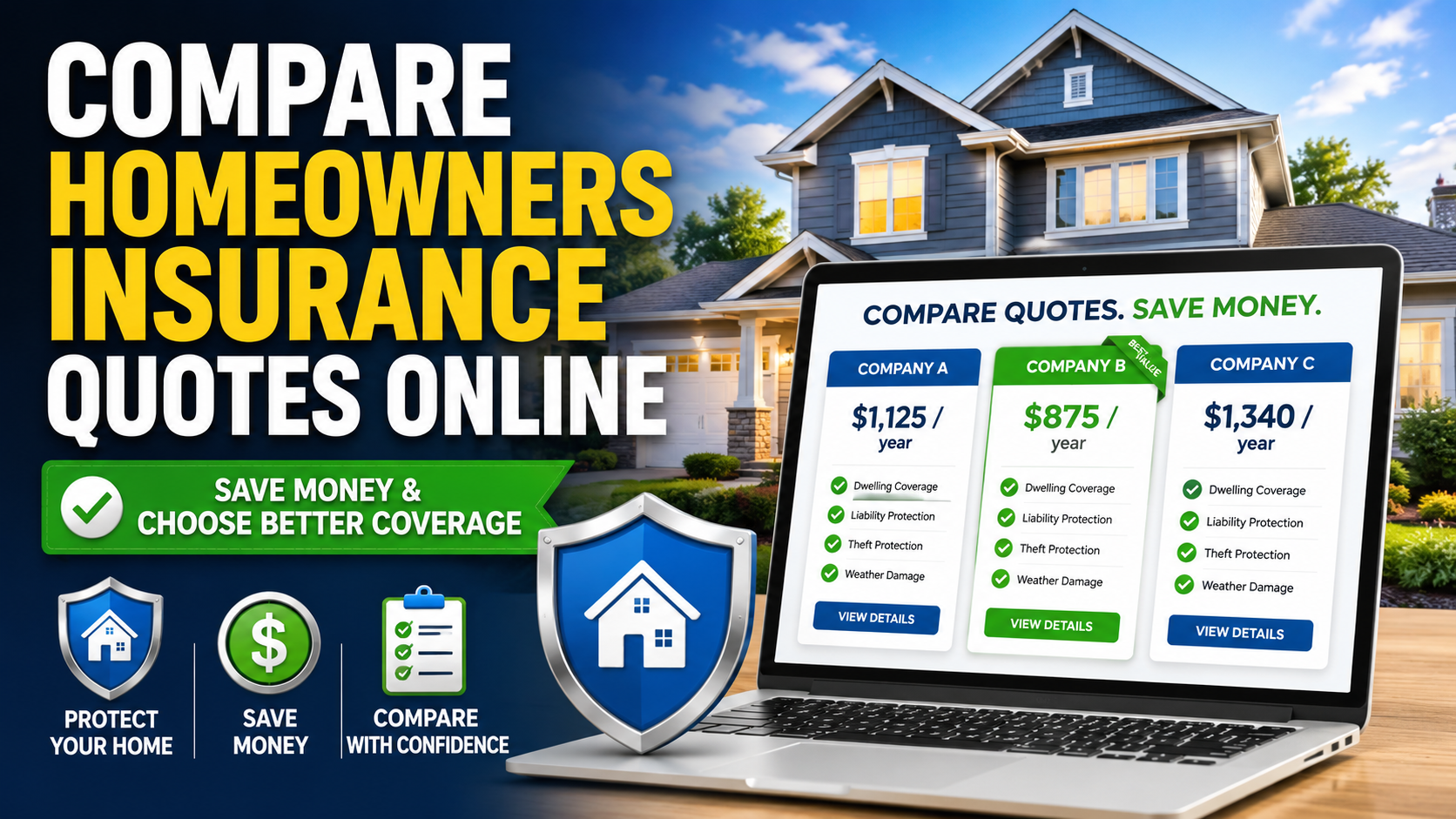
Compare Homeowners Insurance Quotes Online
Comparing homeowners insurance quotes online can help you find a policy that fits your home, your budget, and your risk level. But the cheapest quote is not always the best choice.
A good homeowners insurance policy should protect your house, personal belongings, liability risk, and living costs if your home becomes unlivable after a covered loss. Most mortgage lenders also require homeowners’ insurance when you have a home loan.
This guide explains how to compare homeowners insurance quotes online in a simple, practical way.
What Does It Mean to Compare Homeowners Insurance Quotes Online?
To compare homeowners insurance quotes online means checking prices and coverage options from different insurance companies before buying a policy.
A quote is an estimate of what you may pay. It is usually based on details such as:
- Your home location
- Home age and condition
- Rebuild cost
- Roof type and age
- Deductible amount
- Coverage limits
- Claims history
- Safety features
- Optional add-ons
Online quotes are useful, but they are not always final. The final premium may change after the insurance company reviews your home details, claim history, or inspection results.
Why Homeowners Insurance Quotes Can Be Different
Two companies may give very different prices for the same home. This happens because each insurer uses its own pricing method.
Some common factors that affect your premium include the cost to rebuild the home, home materials, distance from a fire department or water source, age and condition of the home, claim history, coverage choices, deductible amount, and discounts. The NAIC explains that different insurance companies may charge different premiums for similar coverage.
That is why comparing only one quote is risky. You may miss a better option.
What Homeowners Insurance Usually Covers
A standard homeowners policy often includes several main coverage parts.
| Coverage Type | What It Usually Helps Cover |
|---|---|
| Dwelling coverage | Damage to the main house |
| Other structures | Detached garage, fence, shed, or similar structures |
| Personal property | Furniture, clothes, electronics, and other belongings |
| Loss of use | Extra living costs if your home is temporarily unlivable |
| Personal liability | Legal or financial responsibility if someone is injured or property is damaged |
| Medical payments | Small medical bills for guests injured on your property |
Homeowners policies usually cover only losses caused by covered risks, also called “perils.” Some policies cover many risks except for listed exclusions, while others only cover named risks.
What Homeowners Insurance May Not Cover
This is where many homeowners make mistakes.
Standard homeowners insurance does not usually cover everything. Flood damage and earthquake damage are often not included in a standard policy, although separate coverage or endorsements may be available.
Common exclusions may include:
- Flood damage
- Earthquake damage
- Normal wear and tear
- Pest damage
- Poor maintenance
- Some types of mold damage
- Sewer backup, unless added
- High-value items above policy limits
Always read the exclusions before choosing a policy.
How to Compare Homeowners Insurance Quotes Online
1. Gather Your Home Details First
Before you request quotes, prepare basic information about your home.
You may need:
- Home address
- Year built
- Square footage
- Roof age and material
- Heating and electrical system details
- Number of stories
- Type of foundation
- Security system details
- Fire alarm or smoke detector details
- Recent renovations
- Current insurance policy, if you have one
Correct details help you get more accurate quotes.
2. Compare the Same Coverage Limits
Do not compare one cheap policy with low coverage against another policy with stronger coverage. That is not a fair comparison.
Try to keep these items the same across all quotes:
- Dwelling coverage amount
- Personal property limit
- Liability limit
- Deductible
- Loss of use coverage
- Roof coverage type
- Replacement cost or actual cash value
The NAIC recommends comparing dwelling limits, personal property limits, liability protection, medical payments, deductibles, and replacement cost versus actual cash value when reviewing homeowners insurance offers.
3. Understand Replacement Cost vs Actual Cash Value
This is one of the most important parts of comparing homeowners insurance quotes online.
Replacement Cost Value, or RCV, helps pay to repair or replace damaged property using similar materials without subtracting for age and wear.
Actual Cash Value, or ACV, usually subtracts depreciation. That means an older property may have a lower payout.
NAIC explains that ACV considers age and wear and tear, while RCV is based on the cost to repair or replace damaged property with materials of similar kind and quality.
A cheaper quote may look attractive, but if it uses ACV instead of RCV, your claim payout may be lower.
4. Check the Deductible
The deductible is the amount you pay before insurance starts paying for a covered claim.
For example:
If your covered damage is $8,000 and your deductible is $1,000, the insurer may pay $7,000, depending on your policy terms.
Some policies have more than one deductible, such as:
- Standard deductible
- Wind or hail deductible
- Hurricane deductible
- Roof deductible
- Percentage deductible
A higher deductible can lower your premium, but it also increases your out-of-pocket cost after a claim.
5. Look at Liability Coverage
Liability coverage can protect you if someone claims you caused injury or property damage.
For example:
- A guest slips on your stairs
- Your dog injures someone
- Your child damages someone else’s property
- You are sued after an accident connected to your home
Do not choose liability limits only by price. Choose an amount that fits your assets and risk.
6. Review Personal Property Coverage
Personal property coverage helps protect belongings such as furniture, clothing, appliances, electronics, and other personal items.
But some items may have special limits, such as:
- Jewelry
- Watches
- Art
- Collectibles
- Musical instruments
- Cameras
- Business equipment
If you own expensive items, ask about scheduled personal property coverage or endorsements.
7. Check Discounts
Many insurance companies offer discounts. These may vary by company and state.
Common discounts include:
- Home and auto bundle
- Security system discount
- Smoke detector discount
- New home discount
- Claims-free discount
- Loyalty discount
- New roof discount
- Automatic payment discount
Discounts are helpful, but they should not be the only reason to choose a company.
Simple Quote Comparison Checklist
Use this checklist before choosing a policy.
| Item to Compare | Why It Matters |
|---|---|
| Annual premium | Shows the basic yearly cost |
| Dwelling limit | Should reflect rebuild cost, not market price |
| Deductible | Affects claim payout and out-of-pocket cost |
| RCV or ACV | Changes how claims are paid |
| Roof coverage | Important for wind, hail, and storm claims |
| Personal property limit | Protects your belongings |
| Liability limit | Protects against lawsuits and injury claims |
| Loss of use | Helps with temporary living costs |
| Exclusions | Shows what is not covered |
| Company reputation | Claims service matters after damage |
Example: Cheap Quote vs Better Quote
Here is a simple example.
| Quote | Annual Premium | Deductible | Personal Property | Claim Payment Type |
|---|---|---|---|---|
| Company A | $1,150 | $2,500 | ACV | Lower claim payout possible |
| Company B | $1,320 | $1,000 | RCV | Better claim protection |
| Company C | $1,400 | $1,000 | RCV + extra water backup | Stronger coverage |
Company A looks cheaper, but it has a higher deductible and ACV coverage. Company B may be a better value if you want stronger protection. Company C may be best if water backup is a concern in your area.
The best quote is not always the lowest price. It is the best balance of price, coverage, deductible, and claim support.
Common Mistakes When Comparing Quotes Online
Choosing Only the Lowest Price
A low premium may mean lower coverage, higher deductibles, or more exclusions.
Using Market Value Instead of Rebuild Cost
Your dwelling coverage should focus on the cost to rebuild the house, not the home’s selling price. NAIC explains that replacement cost is different from market value because market value includes land and depends on the real estate market.
Ignoring Flood or Earthquake Risk
If you live in a flood-prone or earthquake-prone area, ask about separate coverage.
Not Checking Roof Terms
Some policies may cover roofs differently based on age or condition. This can affect storm or hail claims.
Forgetting About Personal Belongings
A basic quote may not fully protect expensive items. Review special limits carefully.
Not Reviewing the Company
Price matters, but claim service also matters. Check financial strength, complaint history, and customer reviews from reliable sources.
Tips to Get Better Homeowners Insurance Quotes Online
You may be able to improve your quote by taking smart steps.
- Compare at least three quotes
- Use the same coverage limits for each quote
- Choose a deductible you can afford
- Ask about bundle discounts
- Update your home safety features
- Review your roof condition
- Keep a home inventory
- Ask about replacement cost coverage
- Review your policy every year
- Avoid underinsuring your home
A home inventory can also help you track personal property and valuables. NAIC recommends keeping records of personal property when shopping for homeowners insurance.
When Should You Compare Homeowners Insurance Quotes?
You should compare quotes when:
- Buying a new home
- Renewing your current policy
- Your premium increases
- You renovate your home
- You replace your roof
- You add security features
- You buy expensive personal items
- Your coverage needs change
- You feel your current policy is too expensive
Even if you are happy with your current insurer, checking the market can help you confirm that your coverage and price still make sense.
FAQs About Comparing Homeowners Insurance Quotes Online
Is it safe to compare homeowners insurance quotes online?
Yes, it can be safe if you use trusted insurance company websites, licensed agencies, or reputable comparison platforms. Avoid websites that ask for unnecessary personal information or seem unclear about how your data will be used.
How many homeowners insurance quotes should I compare?
Compare at least three quotes. More quotes can give you a better view of price and coverage options.
Does getting a homeowners insurance quote affect my credit score?
Insurance companies may use credit-based insurance scores in some states, but this is different from applying for a loan. Rules vary by state, so check with the insurer or your state insurance department.
Is homeowners insurance required?
Homeowners insurance is not usually required by law, but mortgage lenders generally require it if you have a mortgage.
What is the most important thing to compare?
Compare coverage first, then price. A cheap policy with weak coverage may cost more later if you file a claim.
Can I switch homeowners insurance anytime?
In many cases, yes. But check for cancellation rules, refund terms, and mortgage escrow requirements before switching.
Should I buy homeowners insurance online or through an agent?
Both options can work. Buying online may be faster. An agent may help explain coverage details, discounts, and policy differences.
Final Thoughts
Comparing homeowners insurance quotes online is a smart way to find better coverage and avoid overpaying. But price should not be the only factor.
Look closely at dwelling coverage, deductibles, replacement cost, personal property limits, liability coverage, exclusions, and company reputation. The right policy should protect your home properly and fit your budget without leaving major gaps.
Disclaimer
The information in this article is for general educational purposes only. It is not financial, legal, or insurance advice. Homeowners insurance costs, coverage options, discounts, deductibles, and policy terms can vary by insurance company, location, property condition, and personal details.
Always review the full policy documents before buying insurance. For accurate advice, speak with a licensed insurance agent, insurance company, or qualified professional in your area.