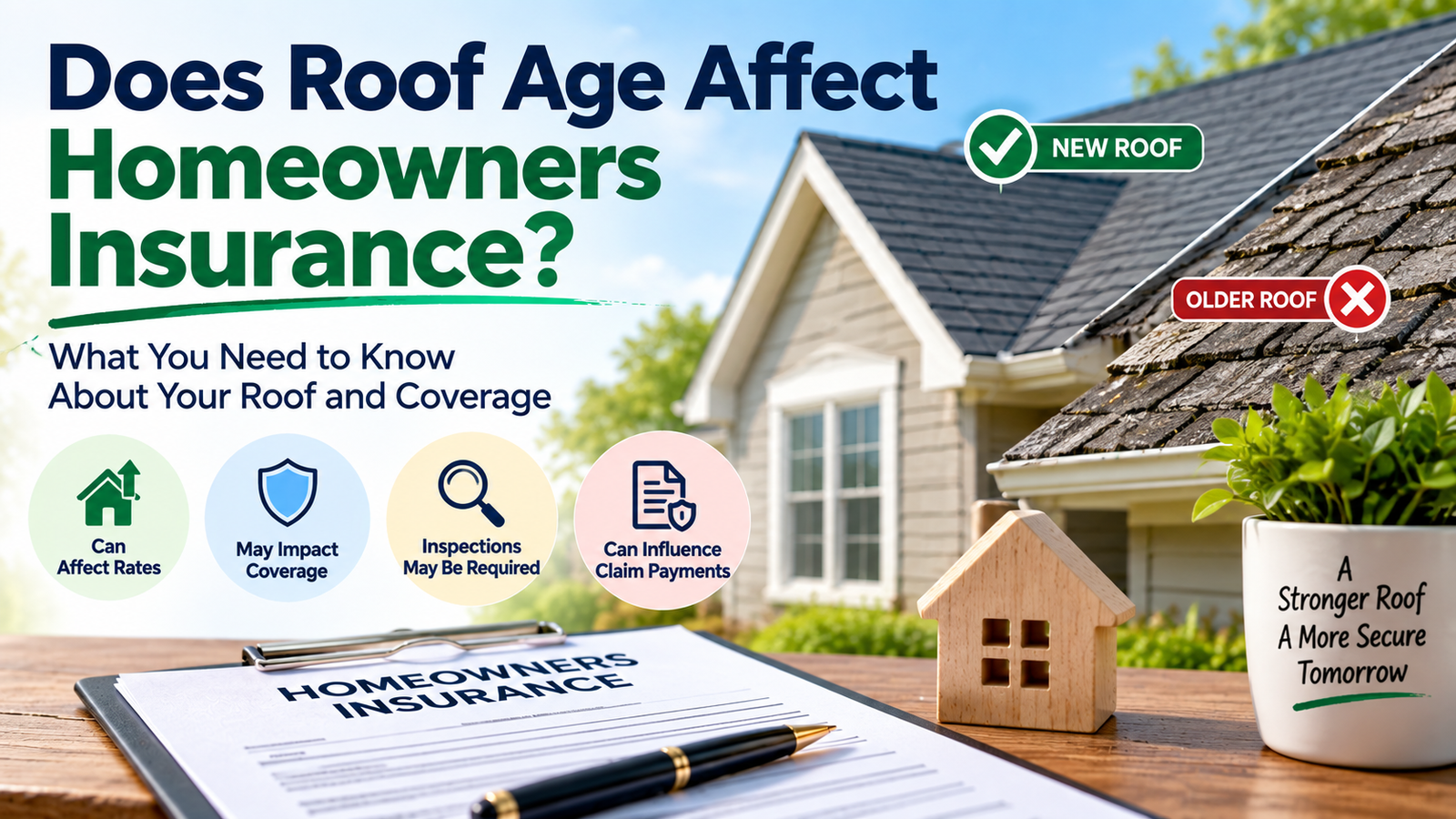
Does Roof Age Affect Homeowners Insurance?
Yes. The age of your roof can affect homeowners insurance rates, coverage, claim payments, and even whether an insurance company is willing to insure the home.
A newer, well-maintained roof generally presents less risk to an insurer than an aging or deteriorated roof. Older roofs are more vulnerable to leaks, wind damage, hail damage,e and other problems that can lead to expensive insurance claims.
The Insurance Information Institute says roof age and condition can influence how an insurance company evaluates a property and determines coverage. It also notes that when a roof is more than about 20 years old, many insurers may require an inspection before issuing coverage, while some insurers may decline the property or cover the roof only for its depreciated value.
That does not mean every 15- or 20-year-old roof automatically causes a premium increase or insurance cancellation.
Insurance companies use different underwriting rules.
Roof material matters.
Condition matters.
Location matters.
Previous losses matter.
And a 20-year-old roof that has been carefully maintained can present a very different risk from a badly damaged roof of the same age.
The key point is simple:
As a roof gets older, it becomes more important to understand how your insurance company values and covers it.
Why Does Roof Age Matter to Homeowners Insurance Companies?
Your roof is one of the home’s primary defenses against weather.
When it performs properly, it helps keep wind, rain, hail, and other hazards from damaging the interior of the property.
When a roof deteriorates, a relatively small problem can lead to a much larger loss.
A damaged roof might allow water into:
- Ceilings
- Walls
- Insulation
- Electrical systems
- Flooring
- Furniture
- Personal belongings
The Insurance Information Institute explains that an old or poorly maintained roof can increase the risk of damage to the home and its contents.
From an insurer’s perspective, this increases the probability and potential severity of a future claim.
That is why roof age may affect several parts of your insurance relationship:
- Your premium
- Eligibility for a new policy
- Renewal decisions
- Inspection requirements
- Available roof coverage
- Claim settlement method
- Discounts
- Deductibles
Roof age is therefore not simply a maintenance issue.
It can become an insurance issue too.
Does an Older Roof Increase Homeowners Insurance?
It can.
Insurance companies generally view a newer roof more favorably because it is less likely to fail from ordinary deterioration and may be better able to withstand weather.
An older roof may lead to a higher premium depending on the insurer, location,n and roof condition.
It can also mean that certain discounts available for a recently replaced roof disappear as the roof ages.
Current Insurance.com data shows that a roof upgrade produces an average homeowners insurance discount of about 11%, although actual savings vary by insurer, state, roof type, pe and property.
That does not mean replacing every roof will automatically lower the premium by 11%.
Some homeowners may save more.
Some may save less.
Some insurers may provide no specific roof discount at all but may still view the property more favorably for underwriting.
The only way to know your actual savings is to ask your insurer to recalculate the policy after the replacement.
How Old Can a Roof Be for Homeowners Insurance?
There is no single nationwide roof-age limit that applies to every insurer.
Different insurance companies have different underwriting rules.
However, roof age becomes increasingly important as the roof approaches the later part of its expected life.
The Insurance Information Institute says that when a roof is over 20 years old, many insurers may require an inspection when a homeowner applies for insurance. Some insurers may decline to issue a new policy, while others may agree to insure the home but provide only actual-cash-value coverage for the roof.
That makes the 20-year point important—but it is not a universal legal cutoff.
An insurer could begin applying stricter requirements sooner.
Another might continue offering coverage beyond 20 years if the roof passes inspection and remains in good condition.
Roof material also makes a difference.
A company may view a particular roofing system differently based on its construction, durability, condition, and local weather exposure.
What Happens When a Roof Reaches 10 Years Old?
For many homes, a 10-year-old roof is still relatively far from the point where age alone makes the property difficult to insure.
But the roof is no longer new.
An insurer may consider:
- Overall condition
- Signs of deterioration
- Prior storm damage
- Missing or damaged materials
- Maintenance history
- Roof material
- Local hail or wind exposure
Age by itself may not cause a dramatic premium change at exactly 10 years.
However, if a homeowner previously received a new-roof discount, that discount may become smaller as the roof gets older.
This is why it is useful to separate roof age from roof condition.
A poorly maintained 8-year-old roof can present more risk than a carefully maintained 12-year-old roof.
Insurance underwriting often considers both.
What About a 15-Year-Old Roof?
A 15-year-old roof can receive more scrutiny than a newer one, particularly if it uses roofing materials approaching the later portion of their expected useful life.
This does not automatically mean the home will be denied coverage.
Instead, the insurer may:
- Ask questions about the roof
- Review photographs
- Conduct an exterior inspection
- Request documentation
- Look for deterioration
- Change available roof coverage
- Remove a roof-related discount
If you are shopping for homeowners insurance with a roof around this age, ask each company specifically how it handles older roofs.
Do not assume that every insurer follows the same rules.
Can You Get Homeowners Insurance With a 20-Year-Old Roof?
Possibly, yes.
A 20-year-old roof does not automatically mean your home is uninsurable.
But obtaining new coverage can become more difficult.
The Insurance Information Institute says many insurers will require a roof older than 20 years to pass an inspection before issuing coverage. Other insurers may refuse to write the policy or may cover the roof at actual cash value instead of replacement cost.
Insurance.com similarly notes that homes with aging roofs may face additional underwriting scrutiny, difficulty obtaining new policies,cies or possible changes in the type of roof coverage available.
If you have a 20-year-old roof, ask prospective insurers four questions:
Will you insure the home with this roof?
Is an inspection required?
Will the roof receive replacement-cost or actual-cash-value coverage?
Will the roof’s age affect my premium or deductible?
Those answers may matter more than the advertised premium.
Can an Insurance Company Require You to Replace an Old Roof?
An insurer can have underwriting requirements for properties it agrees to insure, subject to applicable state insurance laws and policy rules.
If an inspection shows that a roof is badly deteriorated or creates an unacceptable risk, the company may require repairs or replacement as a condition of obtaining or continuing coverage.
The exact options available to the insurer vary by state and situation.
This is one reason homeowners should not wait until the roof is visibly failing before thinking about replacement.
A deteriorating roof can become harder to insure at the same time that replacement becomes more urgent.
If your insurer requests roof work, ask for the requirement in writing and confirm:
- What must be repaired or replaced
- The deadline
- What documentation is required
- Whether a professional inspection will satisfy the requirement
- Whether the premium will change afterward
Can an Insurance Company Refuse a Home Because of Roof Age?
It can happen.
Insurers evaluate whether properties meet their underwriting guidelines.
Triple-I notes that some insurers may decline new policies for buildings with older roofs.
However, age is not always the only issue.
A company may consider age together with:
- Roof condition
- Material
- Shape
- Previous losses
- Geographic risk
- Weather exposure
- Maintenance
- Inspection findings
Another insurer may have different requirements.
If one company declines a property solely because of an older roof, that does not automatically mean every company will do the same.
Shopping around can matter significantly when insuring an older property.
Does Roof Age Affect a Homeowners Insurance Claim?
Yes, especially when the policy uses actual cash value for the roof.
Roof age can influence how much the insurer pays after covered damage because depreciation may be applied.
There are two important concepts to understand:
Replacement Cost Value (RCV)
and
Actual Cash Value (ACV).
They can produce very different claim payments.
Replacement Cost vs. Actual Cash Value for an Older Roof
With replacement-cost coverage, a policy generally pays the cost to repair or replace covered property using materials of similar kind and quality, subject to the deductible, coverage limit, and policy conditions.
With actual-cash-value coverage, depreciation is deducted.
The National Association of Insurance Commissioners explains that ACV considers age and wear and tear, while replacement-cost coverage generally does not subtract depreciation in the same way.
This difference becomes especially important with an older roof.
Suppose a covered storm causes $20,000 of damage.
If the roof has replacement-cost coverage, the policy may ultimately provide the covered replacement amount according to its terms, minus applicable deductible and limits.
If the roof has actual-cash-value coverage, the insurer may subtract depreciation based partly on age and condition.
That can leave the homeowner paying significantly more.
Example: How Roof Age Can Change an Insurance Payout
Imagine two homeowners each suffer $15,000 of covered roof damage.
Both have a $1,000 deductible.
Homeowner A has replacement-cost coverage.
Homeowner B has actual-cash-value coverage on an older roof.
The NAIC explains that replacement-cost coverage does not deduct depreciation in the same way, while ACV coverage does.
If significant depreciation applies to Homeowner B’s roof, the initial or ultimate covered payment could be substantially smaller depending on the policy terms.
That is why two homeowners with identical damage can receive very different claim settlements.
The difference may have less to do with the storm itself and more to do with how the policy values the roof.
Can an Insurer Change an Older Roof From Replacement Cost to Actual Cash Value?
Some insurers may provide actual-cash-value roof coverage once a roof reaches a certain age, depending on their policy form, underwriting requirements,ements and state rules.
NerdWallet notes that older roofs may be treated as an exception even when the rest of the dwelling receives replacement-cost coverage. Some insurers can move aging roofs to ACV treatment because older roofs are more vulnerable to storm damage and depreciation.
Do not assume the entire house uses one claim-settlement method.
A policy can potentially provide replacement-cost coverage for much of the dwelling while applying different settlement provisions to the roof.
Read the declarations, endorsements, segments, and roof-related provisions carefully.
Does Homeowners Insurance Pay for an Old Roof Just Because It Needs Replacement?
Usually not.
Homeowners insurance is designed to cover covered losses—not routine aging and maintenance.
An insurer generally will not pay for a new roof simply because the existing roof has reached the end of its useful life.
NerdWallet notes that insurance generally does not pay for roof replacement when the problem results from ordinary wear, deterioration,ioration or lack of maintenance rather than a covered event.
For example:
Old shingles wearing out gradually: generally a maintenance issue.
Roof deteriorating because of age: generally not a covered loss by itself.
Sudden covered windstorm damaging an otherwise maintained roof: may be covered according to policy terms.
The cause of the damage matters.
Does Homeowners Insurance Cover Roof Leaks?
Sometimes.
The important question is why the roof leaked.
If a covered event suddenly damages the roof and creates a leak, the resulting damage may be covered subject to your policy.
If the leak develops gradually because the roof is worn out, neglected, or deteriorating from age, coverage may be limited or denied.
NerdWallet’s current roof-leak guidance emphasizes that homeowners insurance generally covers sudden covered events rather than replacing roofs simply because they are old or leaking due to wear and tear.
If you notice a roof problem, deal with it early.
Ignoring a small maintenance issue until it creates extensive interior damage can complicate an insurance claim.
Does a New Roof Lower Homeowners Insurance?
It can.
Replacing an older roof may reduce your homeowners insurance premium because a newer roof generally creates less risk of weather-related damage and leakage.
Current Insurance.com data shows an average roof-upgrade discount of approximately 11%, although the amount varies by insurer, state, roof material,l and individual property.
For example, if a policy costs $3,000 per year, an 11% reduction would equal about $330.
But do not assume you will automatically receive that exact discount.
One insurer may offer a substantial reduction.
Another may simply keep your current rate more favorable.
Another may provide no separate roof discount.
Ask before replacing the roof if insurance savings are part of your decision.
Will Insurance Automatically Know You Replaced Your Roof?
Do not rely on that.
After replacing a roof, notify the insurance company.
It may ask for:
- Contractor invoice
- Completion date
- Roof material
- Building permit
- Photographs
- Inspection
- Warranty information
This documentation can help the insurer update the roof age in its underwriting records.
If you do not tell the company about the replacement, you could miss a discount or continue to have outdated roof information associated with your policy.
Does Roof Material Affect Homeowners Insurance?
It can.
Insurance companies may consider roof material because different materials behave differently during wind, hail, fire, and other hazards.
The effect depends on the insurer and location.
In areas with severe hail or wind exposure, a roof designed to resist those hazards may receive more favorable treatment from some insurers.
However, a more durable roof does not automatically guarantee a lower premium.
Insurers still evaluate the complete property.
When replacing a roof, ask your insurance company whether certain materials, impact-resiratings rating,s or construction standards qualify for discounts.
It can be useful to ask this before selecting the new roofing product.
Roof Age vs. Home Age: They Are Not the Same
A common mistake is assuming an old home automatically has an old roof.
Consider a house built in 1980.
If the roof was replaced in 2024, the house may be more than 40 years old while the roof is only a few years old.
Insurance.com specifically notes that insurers distinguish the age of the home from the age of major systems such as the roof, plumbing, electrical, and heating systems.
That distinction can work in your favor.
Renovating an older property does not make the house itself “new construction,” but upgrading major systems can still improve the home’s insurance risk profile.
Does Roof Condition Matter More Than Roof Age?
Both matter.
Age gives the insurer a general indication of expected deterioration.
Condition tells the insurer what is actually happening today.
A 12-year-old roof with missing shingles, active leaks,s and significant deterioration can present more risk than an older roof that has been professionally maintained and remains structurally sound.
An insurance inspection may evaluate visible issues such as:
- Missing shingles
- Curling or damaged roofing
- Moss or vegetation
- Sagging
- Exposed underlayment
- Improper repairs
- Missing flashing
- Signs of water damage
Maintaining documentation of professional repairs can also be useful when shopping for insurance.
Can a Roof Inspection Help You Get Insurance?
Potentially.
When insurers have concerns about an older roof, an inspection can provide current information about its condition.
Triple-I notes that many insurers may require inspections for roofs older than about 20 years.
A satisfactory inspection may help demonstrate that the roof remains serviceable, although it does not guarantee that every insurer will offer coverage.
If an insurer requests an inspection, ask what type it accepts and whether a licensed roofer, home inspector, or another professional must complete it.
Should You Replace a Roof Just to Lower Insurance?
Usually, insurance savings alone should not be the only reason.
A roof replacement can cost far more than one year’s premium discount.
The better financial question is:
Does the roof need replacement anyway, and will replacing it also improve my insurance situation?
If the roof is aged, deteriorated,d and nearing replacement, insurance savings can be an additional benefit.
If the roof is relatively new and in excellent condition, replacing it just to obtain a modest insurance discount would rarely make economic sense.
Think of the insurance discount as one component of the decision—not the entire decision.
How to Check Whether Your Roof Age Is Hurting Your Insurance Rate
Contact your insurer and ask directly.
You can say:
“How is the age of my roof affecting my homeowners insurance premium and coverage?”
Then ask:
Do I currently receive replacement-cost or actual-cash-value roof coverage?
Would replacing the roof lower my premium?
What discount would apply?
Would certain roofing materials qualify for a larger discount?
Will my current roof age eventually affect renewal eligibility?
Will you require an inspection when the roof reaches a certain age?
These questions give you much more useful information than simply assuming an older roof is increasing the premium.
Questions to Ask Before Buying a Home With an Older Roof
Roof age matters when buying a home too.
Before closing, ask:
- When was the roof installed?
- Is there documentation showing the installation date?
- What material is it?
- Has it been professionally inspected?
- Are there known leaks or repairs?
- Will your insurer provide replacement-cost coverage?
- Does the insurer require replacement?
- Will an inspection be required?
- What deductible applies to wind and hail losses?
Do this before closing, not after.
You do not want to discover after purchasing the property that your preferred insurer will not cover the roof.
Can Roof Age Affect Your Insurance Deductible?
Possibly, although roof age and deductible are separate issues.
Some homeowners policies use special wind, hail, hurricane, or named-storm deductibles.
Those deductibles may be much larger than the standard property deductible.
The interaction between roof age, roof coverage, and catastrophe deductibles can significantly change what you pay after a loss.
For example, an older roof covered on an ACV basis plus a large wind deductible may leave a homeowner responsible for a much larger share of replacement costs than expected.
Always review both:
How the roof is valued
and
What deductible applies
before comparing policies.
How Roof Age Can Affect Your Insurance in Different Ways
The simplest way to understand the relationship is this:
| Roof Situation | Possible Insurance Effect |
|---|---|
| New or recently replaced roof | May qualify for lower rates or discounts |
| Well-maintained mid-age roof | Often insurable under normal underwriting |
| Aging roof | May receive more scrutiny |
| 20+ year roof | May require inspection with some insurers |
| Poor-condition roof | May require repair or replacement |
| Older roof with ACV coverage | Depreciation may reduce claim payment |
| New impact-resistant roof | May qualify for discounts with some insurers |
These are general possibilities rather than universal rules.
Each insurer sets its own underwriting standards subject to state law and approved policy forms.
Frequently Asked Questions About Roof Age and Homeowners Insurance
Does roof age affect homeowners insurance rates?
Yes. Roof age can affect insurance rates because older roofs may be more vulnerable to leaks, storm damage,e and other losses. The effect depends on the insurer, property, roof condition,n and location.
What roof age is too old for homeowners insurance?
There is no universal cutoff. However, Triple-I notes that roofs over about 20 years old often receive greater scrutiny and may require inspection with many insurers.
Will homeowners insurance cover a 20-year-old roof?
It may. A 20-year-old roof can still be covered for sudden damage caused by a covered event, but the insurer may impose different underwriting or claim-settlement terms. Wear and tear itself is generally not covered.
Does replacing an old roof lower homeowners insurance?
It can. Current Insurance.com data shows an average roof-upgrade discount of about 11%, though actual savings vary widely.
Does homeowners insurance cover an old leaking roof?
Coverage depends on what caused the leak. Sudden damage from a covered event may be insured, while ordinary aging, deterioration, and poor maintenance generally are not.
Can my insurer require a roof inspection?
Yes, depending on its underwriting guidelines. Triple-I says many insurers may require an inspection when a roof is more than about 20 years old.
Can homeowners insurance refuse an old roof?
Some insurers may decline to insure properties with roofs that do not meet their underwriting requirements, while others may provide coverage subject to inspection or different roof-settlement provisions.
What is ACV roof coverage?
Actual Cash Value coverage pays based on the depreciated value of the roof after considering factors such as age and wear. This may result in a substantially smaller payment than replacement-cost coverage.
What is replacement-cost roof coverage?
Replacement Cost Value coverage generally pays the covered cost to repair or replace damaged property with materials of similar kind and quality without subtracting depreciation in the same way ACV does, subject to policy conditions, deductible, and limits.
Does home age affect insurance separately from roof age?
Yes. Insurers can evaluate the home’s overall age separately from major systems such as roofing, plumbing,g and electrical systems. Replacing an old roof does not make the entire house new, but it may still improve the home’s insurance risk profile.
Bottom Line: Does Roof Age Affect Homeowners Insurance?
Yes. Roof age can affect your homeowners insurance premium, eligibility, inspections, claim payments, ts and the type of roof coverage available.
A newer roof generally creates less insurance risk and may qualify for a discount.
As a roof gets older, insurers may scrutinize its condition more closely.
When a roof becomes significantly older—particularly around 20 years or more—some insurers may require an inspection, restrict coverage, apply actual-cash-value settlement terms,rms or decline to insure the property.
But age alone does not tell the whole story.
Condition matters.
Material matters.
Maintenance matters.
Location matters.
And each insurer has different underwriting rules.
If your roof is getting older, do not wait until your renewal or a major storm to understand your coverage.
Check your policy now.
Find out whether your roof is covered for replacement cost or actual cash value.
Ask whether roof age is affecting your premium.
Find out whether a replacement would qualify for a discount.
And if you replace the roof, make sure your insurer updates its records.
A roof replacement can be expensive, but discovering after a serious claim that your aging roof had limited coverage can be even more financially painful.
Editorial Disclaimer
This article is provided for general educational and informational purposes only. Insurance underwriting rules, roof-age requirements, premiums, inspections, discounts, deductibles, claims, settlements, and eligibility requirements vary by policy and state. This article is not an insurance quote, legal advice, financial advic,e or a recommendation to purchase or replace a specific roof or insurance policy. Review your actual policy documents and contact your insurer or an appropriately licensed insurance professional for information about your individual situation.