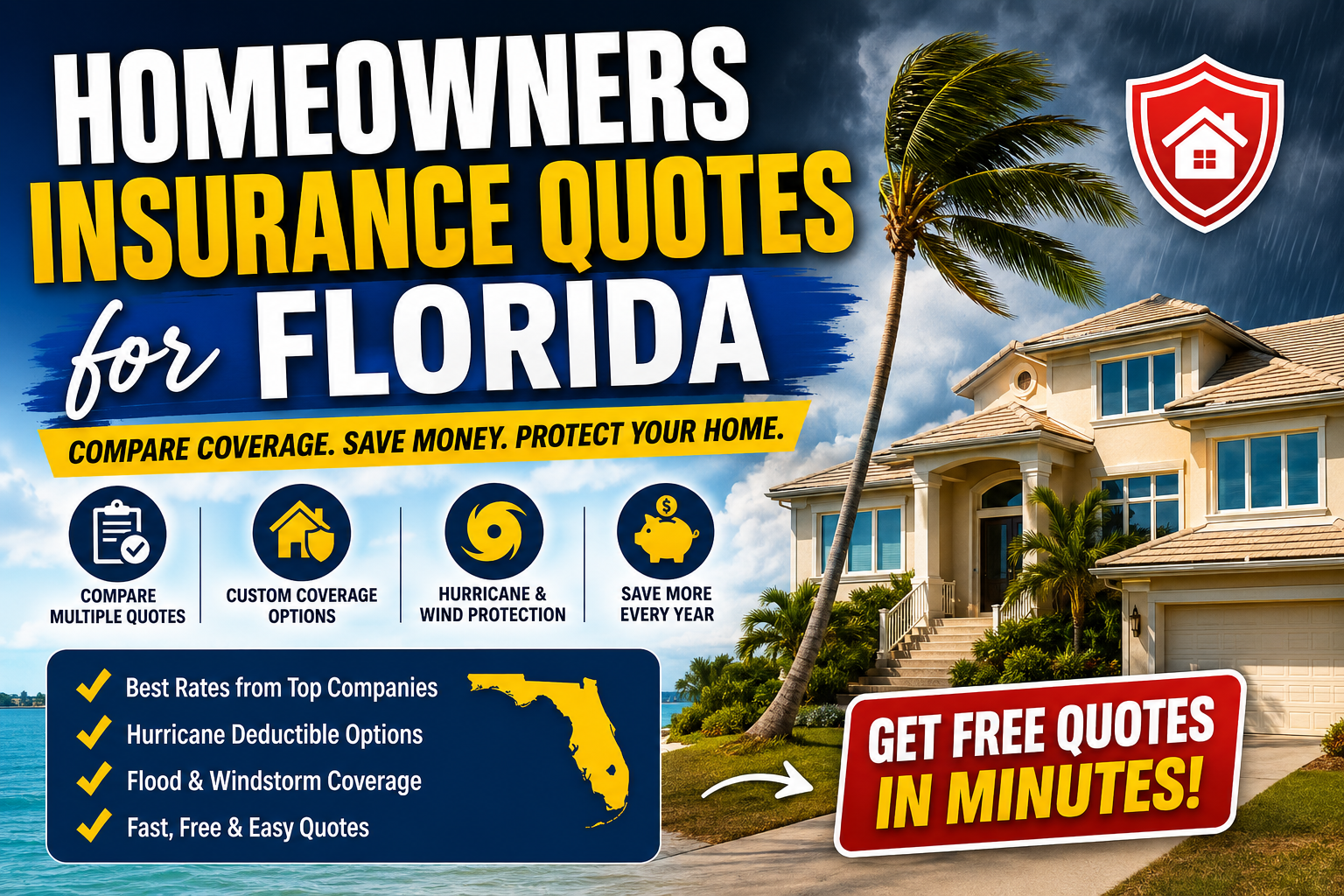
Homeowners Insurance Quotes for Florida: Complete Guide to Compare Coverage and Save Money
Introduction
Finding the right homeowners insurance quotes for Florida can feel confusing. Prices can vary a lot from one company to another, and the lowest quote is not always the best choice.
Florida homes face risks that many other states do not face as often. Hurricanes, windstorms, heavy rain, roof damage, flood risk, and coastal exposure can all affect your insurance quote. Because of this, Florida homeowners should compare more than just price.
A good quote should protect your home, personal belongings, liability risk, and extra living costs if a covered loss makes your home unsafe to live in. Florida’s Office of Insurance Regulation explains that homeowners insurance may cover damage from theft, fire, storm damage, and liability, depending on the policy terms.
This guide explains how to compare Florida homeowners insurance quotes online simply and practically.
What Are Homeowners Insurance Quotes for Florida?
Homeowners insurance quotes for Florida are price estimates from insurance companies based on your home, location, coverage needs, and risk level.
A Florida home insurance quote may include:
- Dwelling coverage
- Other structures coverage
- Personal property coverage
- Liability coverage
- Medical payments coverage
- Loss of use coverage
- Hurricane deductible
- Windstorm coverage
- Optional add-ons
- Discounts
A quote is not always the final price. The insurance company may review your home details, roof condition, claim history, inspection reports, and location before issuing the final policy.
Why Florida Home Insurance Quotes Can Be Expensive
Florida homeowners insurance can cost more than in many other areas because the state has higher weather risk.
Common Florida risk factors include:
- Hurricanes
- Tropical storms
- High winds
- Roof damage
- Flood exposure
- Coastal location
- Older homes
- Older roofs
- High rebuilding costs
- Prior claims
- Limited insurance options in some areas
Insurance companies look at these risks when they calculate your quote. That is why two homes in different Florida counties may receive very different prices, even if the homes look similar.
What Does Florida Homeowners Insurance Usually Cover?
A standard Florida homeowners insurance policy may include several main parts.
| Coverage Type | What It Helps Cover |
|---|---|
| Dwelling coverage | Damage to the main house |
| Other structures | Detached garage, fence, shed, or similar structures |
| Personal property | Furniture, clothing, appliances, electronics, and belongings |
| Loss of use | Temporary housing or extra living costs after a covered loss |
| Personal liability | Legal or financial responsibility if someone is injured or property is damaged |
| Medical payments | Small medical bills for guests injured on your property |
Coverage depends on the policy. Always read the declarations page, exclusions, deductibles, and endorsements before buying.
What Florida Homeowners Insurance May Not Cover
Many homeowners make the mistake of thinking every type of damage is covered. That is not true.
A standard homeowners policy may not cover:
- Flood damage
- Earthquake damage
- Normal wear and tear
- Pest damage
- Poor maintenance
- Some mold damage
- Sewer backup without added coverage
- Some roof issues
- High-value items above policy limits
Flood damage is especially important in Florida. Standard homeowners insurance usually does not cover flood damage. Florida allows private flood insurance, and the Florida Office of Insurance Regulation notes that private flood insurance can be written under Florida law.
If your home has flood risk, ask about flood insurance separately.
How to Compare Homeowners Insurance Quotes for Florida
1. Compare the Same Coverage Limits
Do not compare one low-coverage quote with another full-coverage quote. That can make a cheap policy look better than it really is.
Compare the same:
- Dwelling coverage limit
- Personal property limit
- Liability limit
- Deductible
- Hurricane deductible
- Windstorm coverage
- Loss of use coverage
- Replacement cost or actual cash value
This gives you a fair comparison.
2. Check the Dwelling Coverage Amount
Dwelling coverage should be based on the cost to rebuild your home, not the market value of your property.
Market value includes land, location, and real estate demand. Rebuild cost focuses on labor, materials, and construction costs.
For example:
If your home sells for $420,000, that does not automatically mean your dwelling coverage should be $420,000. Your insurance agent or company may use a replacement cost estimate to calculate the proper amount.
3. Review the Hurricane Deductible
Florida homeowners must pay close attention to hurricane deductibles.
Florida’s Department of Financial Services says insurance companies must offer hurricane deductible options of $500, 2%, 5%, or 10% of the policy dwelling or structure limit, unless the percentage deductible is less than $500.
A percentage deductible can be much higher than a regular dollar deductible.
Example:
| Dwelling Coverage | Hurricane Deductible | Your Out-of-Pocket Cost |
|---|---|---|
| $300,000 | 2% | $6,000 |
| $300,000 | 5% | $15,000 |
| $300,000 | 10% | $30,000 |
A quote with a lower premium may have a higher hurricane deductible. Always check this before choosing a policy.
4. Look at Windstorm Coverage
Windstorm coverage is very important in Florida.
Some policies include wind coverage. Others may exclude it or require separate wind coverage, depending on the property and location.
Before buying, ask:
- Is windstorm damage covered?
- Is hurricane damage covered?
- Is there a separate wind or hurricane deductible?
- Are there roof age limits?
- Is the roof covered for replacement cost or actual cash value?
- Are cosmetic damages excluded?
This can make a major difference after a storm.
5. Understand Replacement Cost vs Actual Cash Value
This is one of the biggest quote differences.
Replacement cost coverage helps pay to repair or replace damaged property without subtracting for depreciation.
Actual cash value coverage usually subtracts depreciation based on age and condition.
Example:
If your older roof is damaged, an actual cash value policy may pay less than a replacement cost policy because it may subtract for age and wear.
A cheaper quote may look good now, but it may give you a smaller payout after a claim.
6. Compare Roof Coverage Carefully
Florida insurers often look closely at roof age and roof condition.
When comparing homeowners insurance quotes for Florida, ask:
- Is the roof covered?
- Is it covered at replacement cost or actual cash value?
- Is there a roof age limit?
- Does the policy exclude cosmetic roof damage?
- Does the company require a roof inspection?
- Will a new roof lower the premium?
Your roof can strongly affect your quote, especially in areas with hurricane and wind risk.
Florida Wind Mitigation Discounts
Wind mitigation can help lower the wind portion of your homeowners insurance premium.
Wind mitigation means your home has features that may reduce wind damage, such as:
- Strong roof-to-wall connections
- Hurricane shutters
- Impact-resistant windows
- Better roof deck attachment
- Secondary water resistance
- Strong garage doors
- Hip roof shape
Florida’s Office of Insurance Regulation provides information about premium discounts for hurricane loss mitigation for homes that are hardened or reinforced against wind damage.
A wind mitigation inspection may help prove that your home qualifies for discounts. Florida’s wind mitigation form is known as the Uniform Mitigation Verification Inspection Form, or OIR-B1-1802. The Florida Office of Insurance Regulation says this form is valid for up to five years if no material changes are made to the structure and no inaccuracies are found.
My Safe Florida Home Program
The My Safe Florida Home Program helps eligible Florida homeowners strengthen their homes. The official program website says it offers free wind mitigation inspections and grant assistance for approved upgrades.
This may help some homeowners improve storm protection and possibly qualify for wind mitigation credits.
Program rules, funding, and eligibility can change, so check the official program before applying.
Citizens Property Insurance in Florida
Citizens Property Insurance Corporation is Florida’s insurer of last resort. It may be an option when coverage is not available from private insurance companies or when private options are too expensive compared with Citizens.
Citizens’ flood insurance rules are also important. Citizens says personal residential policies with wind coverage are being phased into flood insurance requirements. Effective January 1, 2026, policies with a dwelling value of $400,000 or more must have flood insurance, and effective January 1, 2027, the requirement applies to all policies regardless of value, with some exceptions.
If you are comparing Citizens with private insurance quotes, check:
- Eligibility rules
- Flood insurance requirements
- Wind coverage
- Deductibles
- Assessments
- Coverage limits
- Depopulation offers
- Renewal rules
Citizens may not always be the best or only option. Compare it carefully with private market quotes.
What Information You Need to Get a Florida Home Insurance Quote
Before requesting quotes, prepare this information:
- Home address
- Year built
- Square footage
- Roof age
- Roof material
- Foundation type
- Number of stories
- Construction type
- Electrical system details
- Plumbing system details
- HVAC age
- Wind mitigation inspection
- Four-point inspection, if available
- Prior insurance details
- Claims history
- Mortgage lender requirements
- Desired deductible
- Desired liability limit
Having this information ready can make your quote more accurate.
Simple Florida Home Insurance Quote Comparison Table
Use this table when comparing quotes.
| Item to Compare | Why It Matters |
|---|---|
| Annual premium | Shows yearly cost |
| Monthly premium | Helps with budgeting |
| Dwelling coverage | Protects the main home structure |
| Hurricane deductible | Can create high out-of-pocket costs |
| Windstorm coverage | Important for Florida storm risk |
| Flood coverage | Usually separate from homeowners insurance |
| Roof coverage | Affects storm and wind claims |
| Personal property coverage | Protects belongings |
| Liability limit | Helps protect against lawsuits |
| Loss of use | Pays extra living costs after covered damage |
| Replacement cost or ACV | Affects claim payout |
| Discounts | May reduce premium |
| Exclusions | Shows what is not covered |
Example: Comparing Florida Homeowners Insurance Quotes
Here is a simple example.
| Quote | Annual Premium | Hurricane Deductible | Roof Coverage | Flood Included? |
|---|---|---|---|---|
| Company A | $2,100 | 5% | Actual cash value | No |
| Company B | $2,450 | 2% | Replacement cost | No |
| Company C | $2,700 | 2% | Replacement cost | Separate flood option available |
Company A has the lowest premium, but the hurricane deductible is higher, and the roof coverage may pay less after a claim.
Company B costs more, but it may offer stronger protection.
Company C costs the most, but it may be useful if the homeowner wants stronger coverage and a flood option.
The best quote depends on your home, budget, and risk level.
Common Mistakes to Avoid
Choosing the Cheapest Quote Only
Low price does not always mean good value. A cheap quote may have weak coverage, high deductibles, or important exclusions.
Ignoring the Hurricane Deductible
A 2%, 5%, or 10% hurricane deductible can create a high out-of-pocket cost. Always calculate the dollar amount.
Forgetting Flood Insurance
Flood insurance is separate from most homeowners’ policies. Florida homeowners should check flood risk even if they are not near the beach.
Not Asking About Wind Mitigation
Wind mitigation discounts can matter in Florida. Ask if your home qualifies.
Not Reviewing Roof Terms
Roof age, roof condition, and roof payment type can affect both price and claim payout.
Comparing Different Coverage Levels
A quote with lower dwelling coverage may look cheaper, but it may leave you underinsured.
Not Checking the Company
Look at claim service, financial strength, complaints, and customer support before choosing.
Tips to Get Better Homeowners Insurance Quotes for Florida
Here are practical ways to compare smarter:
- Get at least three quotes
- Compare the same coverage limits
- Ask about hurricane deductible options
- Ask if windstorm coverage is included
- Check if roof coverage is replacement cost or actual cash value
- Ask about wind mitigation discounts
- Keep your roof and home systems updated
- Consider a four-point inspection if your home is older
- Ask about home and auto bundling
- Review flood insurance separately
- Keep a home inventory
- Compare quotes before renewal
- Read exclusions before buying
You can also use Florida’s CHOICES rate comparison tool. The Florida Office of Insurance Regulation says CHOICES provides consumers with rate information and shows the importance of shopping for the best policy for their needs.
When Should Florida Homeowners Compare Quotes?
You should compare homeowners insurance quotes when:
- Buying a home
- Renewing your policy
- Your premium increases
- Your roof is replaced
- You complete wind mitigation upgrades
- You install impact windows
- You add a security system
- Your insurer changes your coverage
- Your policy is not renewed
- You move to another Florida county
- You want to check if you are overpaying
Insurance needs can change over time. A quote that worked last year may not be the best option now.
FAQs About Homeowners Insurance Quotes for Florida
What is the best way to compare homeowners insurance quotes for Florida?
The best way is to compare at least three quotes using the same coverage limits, deductibles, hurricane deductible, windstorm coverage, roof coverage, and personal property limits.
Is the cheapest Florida homeowners insurance quote the best?
Not always. The cheapest quote may have higher deductibles, lower limits, or weaker roof coverage. Compare value, not just price.
Does Florida homeowners insurance include flood coverage?
Standard homeowners insurance usually does not include flood damage. You may need separate flood insurance through a private insurer or another flood insurance option.
What is a hurricane deductible in Florida?
A hurricane deductible is the amount you pay before insurance covers hurricane-related damage. In Florida, hurricane deductibles may be offered as $500 or as a percentage of the dwelling or structure limit.
Can wind mitigation lower my Florida home insurance quote?
Yes, it may lower the wind portion of your premium if your home has qualifying wind-resistant features and they are properly documented.
What is a four-point inspection?
A four-point inspection reviews four major home systems: roof, electrical, plumbing, and HVAC. Insurance companies may request it for older homes.
Should I get homeowners insurance online or through an agent?
Both can work. Online quotes are convenient. An agent may help explain Florida-specific coverage, windstorm rules, Citizens eligibility, roof coverage, and flood insurance options.
How often should I compare Florida homeowners insurance quotes?
Compare quotes at least once a year before renewal, or whenever your premium increases or your home changes.
Final Thoughts
Homeowners insurance quotes for Florida should be compared carefully. Do not focus only on the lowest price.
Look at dwelling coverage, hurricane deductibles, windstorm coverage, roof terms, flood risk, replacement cost, liability protection, discounts, and exclusions. Florida homes face unique risks, so the right policy should protect your home properly and still fit your budget.
A smart comparison can help you avoid weak coverage and find better value.
Disclaimer
This article is for general educational purposes only. It is not legal, financial, or insurance advice. Homeowners insurance rates, coverage options, deductibles, discounts, eligibility rules, and policy terms can vary by insurance company, property location, home condition, and Florida law.
Always review the full policy documents before buying coverage. For personal advice, speak with a licensed Florida insurance agent, insurance company, or qualified professional.