
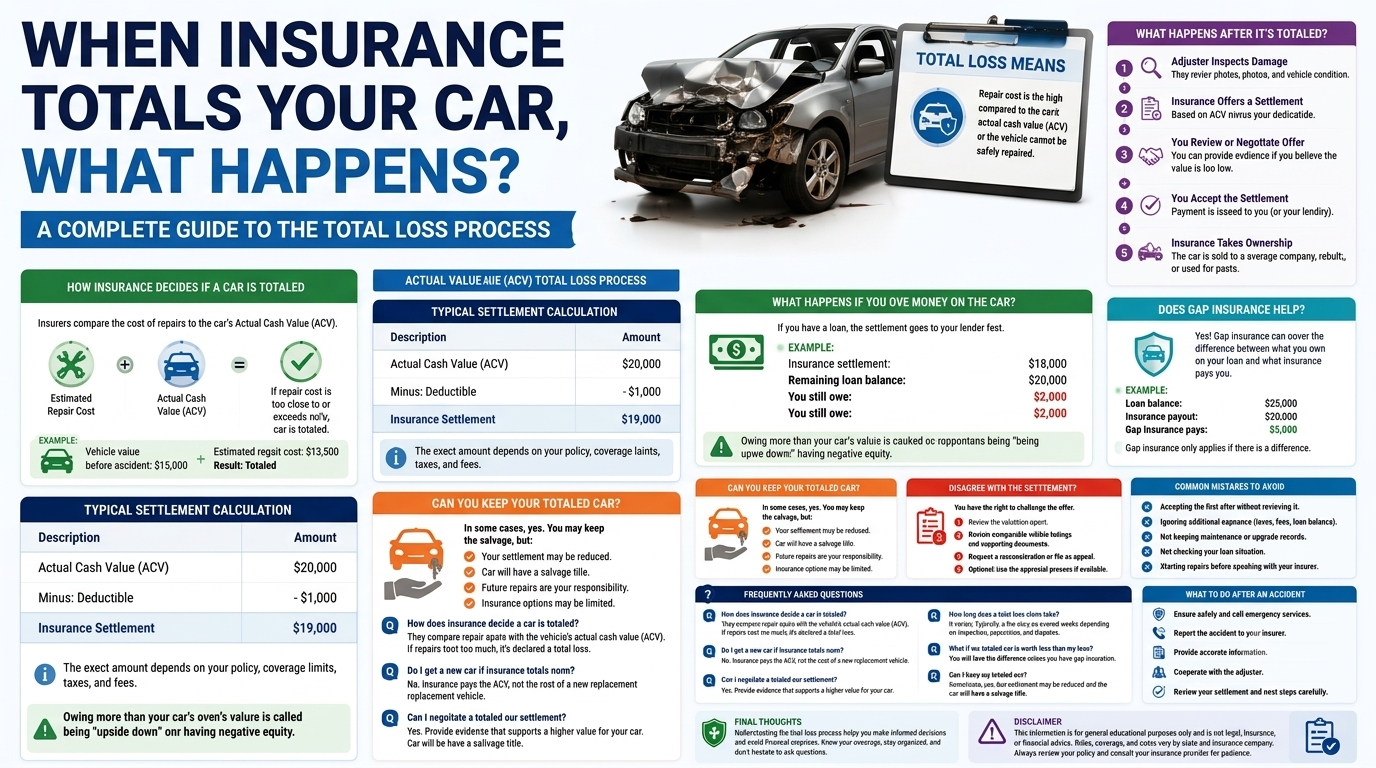
When Insurance Totals Your Car, What Happens? A Complete Guide to the Total Loss Process
Finding out that your car has been declared a total loss can be stressful and confusing. Many drivers are unsure what happens next, how insurance companies decide a vehicle is totaled, and whether they will receive enough money to replace their car.
A common question after a serious accident is:
When insurance totals your car, what happens?
When an insurance company declares your vehicle a total loss, it means the cost of repairing the car is too high compared with its actual value, or the vehicle cannot be safely repaired. Instead of paying for repairs, the insurer usually provides a settlement based on the vehicle’s value before the accident.
The process involves several steps, including vehicle evaluation, settlement calculation, loan handling, and deciding what happens to the damaged vehicle.
What Does It Mean When Insurance Totals Your Car?
A car is considered totaled when an insurance company determines that repairing it is not financially practical.
Insurance companies usually compare:
- Cost of repairs
- Vehicle’s actual cash value (ACV)
- State rules or insurance guidelines
If repair costs are too close to or exceed the vehicle’s value, the insurer may declare it a total loss.
For example:
- Your car’s value before the accident: $15,000
- Estimated repair cost: $13,500
The insurance company may decide that repairing the vehicle does not make financial sense and classify it as totaled.
The exact formula varies by state and insurance company.
How Does Insurance Decide If a Car Is Totaled?
Insurance companies usually send an adjuster to inspect the vehicle and estimate repair costs.
The adjuster reviews:
- Damage severity
- Repair estimates
- Vehicle condition before the accident
- Market value of similar vehicles
- Safety concerns
The insurance company then compares repair costs with the vehicle’s actual cash value.
Actual Cash Value (ACV)
Actual cash value is the estimated market value of your vehicle immediately before the accident.
It considers factors such as:
- Vehicle age
- Mileage
- Condition
- Location
- Previous damage
- Comparable vehicle prices
Insurance companies generally do not pay the original purchase price of your vehicle. They typically pay the current market value.
What Happens After Insurance Declares Your Car a Total Loss?
Once your vehicle is declared totaled, the insurance company usually follows several steps.
The Insurance Adjuster Reviews the Damage
The adjuster completes an inspection and prepares a damage assessment.
They may:
- Review repair estimates
- Take photos
- Check vehicle history
- Determine the vehicle’s value
The Insurance Company Offers a Settlement
After determining the vehicle’s value, the insurer provides a settlement offer.
The payment amount is usually based on:
- Actual cash value
- Deductible amount
- Applicable taxes and fees
- Policy coverage limits
For example:
- Vehicle value: $20,000
- Deductible: $1,000
- Settlement amount: $19,000
The exact amount depends on your policy and local rules.
You Accept or Negotiate the Settlement
You do not always have to accept the first settlement offer.
If you believe the valuation is too low, you may provide evidence such as:
- Recent maintenance records
- Vehicle upgrades
- Comparable vehicle listings
- Service history
A strong documentation record can help support your position.
What Happens to the Car After It Is Totaled?
After a total loss settlement, the insurance company usually takes ownership of the damaged vehicle.
The vehicle may be:
- Sold to a salvage company
- Repaired and rebuilt
- Sold for parts
The process depends on the damage level and local regulations.
In some cases, the owner may be allowed to keep the totaled vehicle, but the insurance payout may be reduced by the salvage value.
What Happens If You Still Owe Money on a Totaled Car?
If you have a car loan, the insurance payment usually goes toward paying the remaining loan balance first.
Example:
- Insurance settlement: $18,000
- Remaining loan balance: $20,000
You would still owe the lender $2,000.
This situation is called being upside down or having negative equity on your vehicle.
Does Gap Insurance Help If Your Car Is Totaled?
Gap insurance may help if you owe more on your loan than your car is worth.
Example:
- Remaining loan balance: $25,000
- Insurance payout: $20,000
- Gap coverage may help cover the $5,000 difference
Gap insurance usually applies only when there is a difference between your vehicle’s value and your loan balance.
Can You Keep Your Car After Insurance Totals It?
In some situations, you may be able to keep your totaled vehicle.
This is sometimes called keeping the salvage.
However:
- Your settlement may be reduced
- The vehicle may receive a salvage title
- Future repairs may be your responsibility
- Insurance options may become limited
Before keeping a totaled vehicle, consider repair costs, safety, and resale value.
What If You Disagree With the Insurance Settlement?
Insurance valuations are not always perfect. If you believe your vehicle is worth more, you can challenge the offer.
Steps you can take:
Review the Valuation Report
Ask the insurer how they calculated your vehicle’s value.
Look for:
- Incorrect mileage
- Wrong trim level
- Missing features
- Incorrect vehicle condition
Provide Comparable Vehicle Evidence
Find similar vehicles for sale with:
- Similar year
- Similar mileage
- Similar condition
- Similar features
Request a Reconsideration
Contact the insurance company and provide supporting information.
Some policies may also include an appraisal process for valuation disputes.
Common Mistakes After a Car Is Totaled
Accepting the First Settlement Offer Immediately
The first offer may not always reflect your vehicle’s true market value.
Review the calculation before accepting.
Forgetting About Additional Expenses
A total loss settlement may not cover:
- Replacement vehicle costs
- Registration fees
- Taxes
- Remaining loan balance
Plan for these expenses.
Not Keeping Documentation
Keep records of:
- Repairs
- Maintenance
- Vehicle upgrades
- Accident paperwork
These documents can support your claim.
Ignoring Your Loan Situation
If you owe more than your car’s value, understand how the remaining balance will be handled.
What Happens If the Other Driver Caused the Accident?
If another driver caused the accident, their liability insurance may cover your vehicle damage.
The process may involve:
- Filing a claim with their insurer
- Waiting for fault determination
- Negotiating the settlement
You may also use your own collision coverage if available and allow your insurer to seek reimbursement from the other party.
Frequently Asked Questions About Total Loss Insurance Claims
How does insurance decide a car is totaled?
Insurance companies compare repair costs with the vehicle’s actual cash value. If repairs are too expensive compared with the car’s value, they may declare it a total loss.
Do I get a new car if insurance totals mine?
Usually, no. Insurance typically pays the vehicle’s actual cash value, not the cost of a brand-new replacement vehicle.
Can I negotiate a totaled car settlement?
Yes. You may provide evidence showing your vehicle was worth more than the insurer’s valuation.
How long does a total loss insurance claim take?
The timeline varies depending on vehicle inspection, paperwork, valuation disputes, and settlement approval.
What happens if my totaled car is worth less than my loan?
You may still owe money after the insurance payout. Gap insurance may help cover the difference if you have that coverage.
Can I keep my totaled car?
In some cases, yes. However, keeping the vehicle may reduce your settlement and create additional repair and insurance challenges.
Final Thoughts: Understanding the Total Loss Process
When insurance totals your car, it does not mean you automatically receive enough money to buy an identical replacement vehicle. The insurance company usually pays based on the vehicle’s actual cash value before the accident.
The most important steps are:
- Understand how your vehicle was valued
- Review the settlement offer carefully
- Gather evidence if you disagree
- Check your loan balance
- Know your options before accepting payment
Understanding the total loss process helps you make better decisions and avoid financial surprises after a serious accident.
Disclaimer
The information provided in this article is for general educational purposes only and should not be considered legal, insurance, or financial advice.
Insurance rules, total loss calculations, settlement procedures, and vehicle valuation methods vary by state, insurance company, and individual policy. Always review your insurance contract and consult your insurance provider or a qualified professional for advice specific to your situation.
This article does not guarantee a specific settlement amount, claim outcome, or insurance decision.